
13 September 2013
Cat Hellisen, Sarah Lotz and I hosted our first Young Adult masterclass at the Open Book festival on Wednesday 11 September 2013.

13 September 2013
Cat Hellisen, Sarah Lotz and I hosted our first Young Adult masterclass at the Open Book festival on Wednesday 11 September 2013.
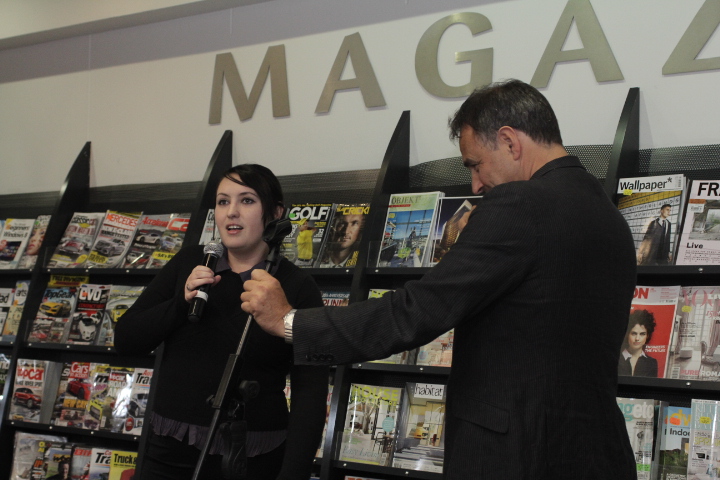
Anthony Horowitz kicked off his South African tour with an appearance at Exclusive Books V&A Waterfront. It was a great privilege to introduce the best-selling author to the crowd, and an even greater privilege to soak in the knowledge of one of my all-time favourite authors.

23 May 2013
It’s difficult to come back down to earth after a weekend of non-stop celebration, but that’s what it felt like after this weekend’s Franschhoek Literary Festival. It was a whirlwind of friends, wine, good food and happy memories.
24 September 2012
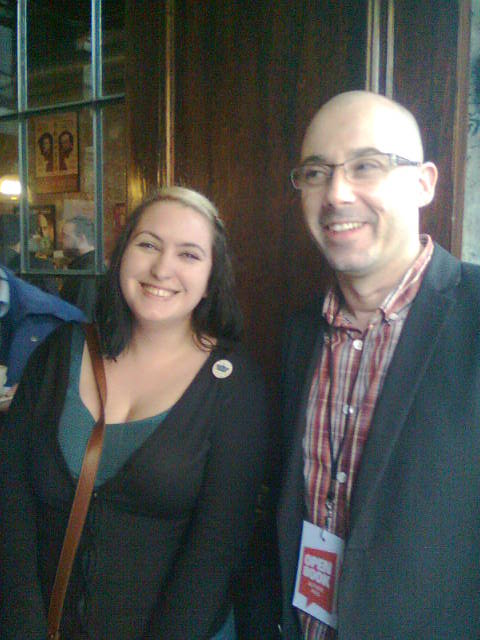
As part of the annual Open Book Festival I was invited to participate in a panel about censorship in teen publishing. I was joined by Scottish young adult author Keith Gray (Ostrich Boys, Next) The Book Lounge’s Verushka Louw and librarian Lona Gericke.

27 October 2012
Oh man, I really love Halloween.
This year I once again took part in South African Horrorfest’s literary event, Bloody Parchment, that took place at the Book Lounge on 26 October 2012.
16 June 2012
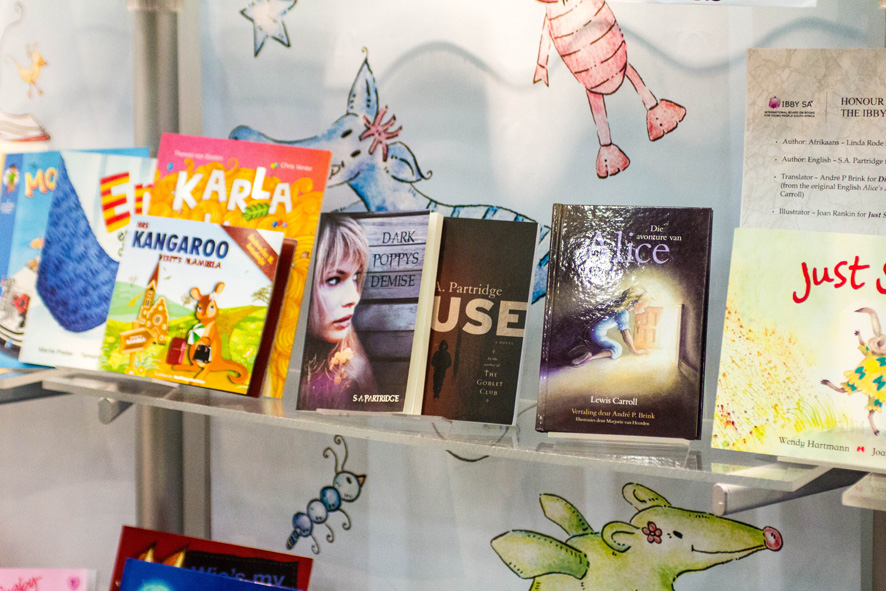
The Cape Town Book got off to a bustling start on Day 2 as thousands of book lovers descended on the CTICC.
There was so much happening it was hard to keep track.
In the morning, Modjaji authors and Sunday Times Literary Award nominees Yewande Omotoso and Tracy Farren spoke about their lives at Poetry Café.
Later the ladies were available to sign copies of their books at the Modjaji stand.
Another highlight was seeing acclaimed novelist Sindiwe Magona speaking about her biography at the ANFASA stand. She attracted such a thick crowd that it was hard to get close enough to hear. There was also a film crew on hand, so hopefully we’ll be seeing Sindiwe on the small screen soon.
The aisles were choc-a-block, but I managed to get some author spotting in. I ran into author Short Story Day South facilitator Rachel Zadok, Karina and Andre Brink, Tiah Beautement, Ben Williams (all the way from Joburg) and I even spotted Jo-Anne Richards in passing. Apologies to Ben for putting my foot in my mouth. I do that. A LOT. (Don’t ask)
A personal highlight was meeting Associated Magazines MD (and hero) Jane Raphaely who signed my copy of her book, Jane Raphaely Unedited. Jane is so poised and elegant, that I felt completely under-dressed in my worn jeans and alice band. Can’t wait to read her book.
I also spoke to Gabriele Lightdancer, who launched her poetry collection and biography at the Book Fair. Her journey from troubled childhood to author was very inspirational and I found that we had a lot in common. I was surprised to discover that the German born-writer lives with her husband in Pretoria.
It’s really great to see so many people excited about reading. Books were flying off the shelves. I made the mistake yesterday of seeing something I wanted and expected it to still be there this morning. Wrong!
Bargain hunters should head to the SCBWI (Society for Children’s Book Writers and Illustrators) stand who are selling 5 POSTERS FOR R10! Bargain Books have also got some great deals on.


I was asked to speak at the Library and Information Association of South Africa (Liasa) end of year function, following in the very big shoes of Margie Orford, who addressed the association last year.
Thank you to Ingrid and Elmarie for inviting me to the event and thanks to new friends Julian, Sue, Wilhemmina, Rheina and Lyn for making me feel welcome.
Here’s my full speech from the event.
If you put young adult fiction in a box you end up with the following:
A novel targeted to a young person aged between thirteen and nineteen that offers an impartial voice on life, on love and the consequences of making the right or wrong decisions.
But its so much more than that isn’t it? It’s a billion dollar industry. Its so lucrative that some publishing houses desperate for the next big thing, hire writing teams and fiction factories to mass produce novels aimed at the youth market. Even beloved YA author L.J Smith was recently fired by her publishers and The Vampire Diaries will continue without her.
But young adult literature, as profitable as it is, is more than just a means for publishing houses to make money.
Let’s look at Stephanie Meyer’s Twilight as an example. Twilight is on its surface, a love story between girl and vampire. We know that the series sparked a global thirst for paranormal romance and a multi-billion dollar movie franchise.
But that is just Twilight in a box. It is so much more than that.
Twilight is a story about a girl who has to say goodbye to the life she knows, who has to start off fresh in a new town, and make friends in a school where the social circles are already established. The story of Bella’s awkward struggle to make friends, the jealousy she encounters, and her inevitable romance with the hottest guy in school could be a novel in itself. And more than just a few of us would read it.
Twilight is also the story of the relationship between a girl and her estranged father, still bitter from a divorce that tore their family apart. The reader follows Bella’s tenuous relationship with Chief Swan falter, and then grow, reminding us of our own relationships with our parents.
It is the story of friendship, and how unrequited feelings can test our relationships with the people we care most deeply about. We witness how Jacob wrestles with his feelings for Bella, wanting to be with her, and not being able to walk away. It’s one of the most honest portrayals of friendship I’ve found.
Twilight is also the story of true love; of selfless thinking; of choice, of family values, of abstinence and also grief.
But most of all, Twilight’s fast-paced plot keeps its readers on the edge of their seats from start to finish.
When I’m asked to speak at functions such as this, my mantra is always that teens want to be entertained as much as adults do, so why should YA fiction be any different from say, commercial fiction? It isn’t.
Twilight has the hero, the love interest, the rival, the villain and as much tension you can fit into four books. This is the recipe for a commercially viable novel. When you add a pinch of wish fulfilment to the mix you’ve got a winner. After all, who doesn’t want to meet the man of their dreams across a crowded cafeteria?
I like a good paranormal romance (who doesn’t?); I also enjoy the occasional dystopian (The Hunger Games are all the rage right now), and when I’m feeling particularly nostalgic; I’ll break out a favourite Point Horror or Harry Potter; but my true love; the one that gets my hair to stand on end, is that YA set in the here and now. Because if you exterminate the zombies, and shoo away the werewolves; you’re left with a bare bones story about love; and friendship, and just how scary being a kid in a very complicated world can be. And it’s that nail biting quality of young adult fiction that I enjoy the most.
As a kid fed on a diet of Nancy Drew and Tintin I was desperate for something good and meaty to read. In the end I resorted to raiding my mother’s Stephen King collection. To my sheer unadulterated glee I discovered characters my own age that I could relate to and whose journey I was genuinely interested in following (unlike the unfortunate Miss Drew and her habit of putting her nose where it didn’t belong)
Remember thirteen year old Mark Petrie from Salem’s Lot? The poor kid who had to face a town infested with vampires? Or what about Apt Pupil’s Todd Bowden who discovers a Nazi hiding in his neighbourhood? Then there was Christine’s nerdy Arnie Cunningham who buys a demonic car, and let’s not forget the boys from Stand By Me that discover a body on the train tracks.
Stephen King knows how to get teenagers just right – their fearless, know it all, me against the world attitude to life, but also their innocence and uncertainty, and their resilience when the odds are stacked against them.
King’s stories would keep me up at night for sure, but each book had me hooked from page one, every time. Mostly because could see myself in the characters.
As a child I used to make up stories about fairies and unicorns to entertain my grandmother. Thanks to Stephen King I was inspired to write far juicer stories – daring tales of a teenage bicycle gangs; and girls who unearth the ghoulish secrets of a haunted house, and of course, how an innocent sleepover could be ruined by the presence of a possessed Barbie Doll in the attic.
I blame Stephen King for my penchant for doing terrible things to young people in my novels. It was the best on the job training that any writer could hope for.
When I wrote my first published novel I didn’t know that I had inadvertently written a young adult novel. To be honest I had no idea that the genre even existed. I was merely adapting my own desire to write to the style I was most interested in; commercial horror fiction; and peopling it with characters I mostly identified with – young people, like me.
So yes, my books do what any young adult novel is supposed to.
They act as a guiding voice to young people – like The Goblet Club, that teachers young people the dire consequences of poisoning their teachers;
They also offer a comment on society; like in Fuse, where I investigate how bullying can lead to acts of school violence and even suicide;
And they also offer a warning, like in Dark Poppy’s Demise that advises caution when meeting people online and illustrates how if something looks too good to be true, it probably is.
But more than this my tales are thrilling; hopefully a little pulse racing; and very, very dark. Just the way I like it.
I’ll end off my talk with a few quotes from Stephen King.
“Schizoid behavior is a pretty common thing in children. It’s accepted, because all we adults have this unspoken agreement that children are lunatics.”
And finally
“If you liked being a teenager, there’s something really wrong with you.”

2 December 2011
This week superstar author Sarah Lotz and I visited Springfield Convent School in Wynberg to chat about our books, what it’s like to be a writer in South Africa, and in Sarah’s case, the trouble she gave her parents as a teenager.
We started off by chatting about our books, Deadlands and Dark Poppy’s Demise, and how we came about to write them.
Sarah and I both love Stephen King, and the more we talked, the clearer it became that true horror lies in what human beings are capable of doing to each other, which is the reason why my novels are set firmly in the here and now and why Sarah’s horror novel The Mall works on both commercial and literary levels.
The grade ten and eleven girls were abuzz with questions; asking us everything from how to get published; where we get our inspiration from; and how long it takes to write a novel; to what time we wake up in the morning and how old we are.
We ended off our visit with a quick reading from both our books.


16 May 2011
I attended the Franschhoek Literary Festival this year as a first-time speaker.
I first attended the festival in 2009 as a guest of my editor Helen Moffett. It was a squeal inducing experience with lots of encounters with my literary heroes (Tom Eaton, Finuala Dowling, Max du Preez etc) and lots of running around in the rain (it was the year that Cape Town experienced that frightening storm to end all storms that managed to blow itself into the winelands).
Continue reading “My first FLF as a panelist” →

 Sally Partridge